Linocut on Instagram: Why I Film the Process
Carving, printing, laser engraving: what I share on @rc_prints_, why printmaking videos show what a finished print hides, and how to ask me questions.
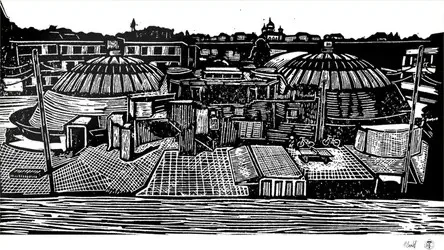
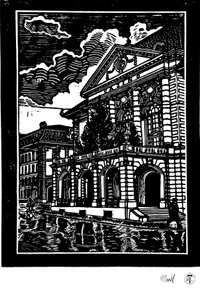
A finished linocut tells you almost nothing about how it was made. You see black lines on white paper, clean and calm. You don’t see the hours before.
That’s why my linocut Instagram, @rc_prints_, exists. It’s where I show the part the finished print hides.
What do I post on @rc_prints_?
To be honest: right now, it’s mostly about the shop. New motifs, what’s available, what’s going out.
Not the most thrilling part, I know. But in between there are the videos, and those are what I actually care about. They show three things:
- Carving: the knife moving through the lino, the design appearing line by line, in mirror image.
- Printing: the moment I lift the sheet off the plate.
- Laser engraving: the laser marking wood and card for labels, boxes and gift tags.
In the carving clips you’ll see my Pfeil knives from Langenthal, with their pear-wood handles. Every line in the shop was cut with them. Once you watch the blade work, you suddenly understand why a background of fine lines takes so long.
The laser might not fit the picture you have of linocut. A lino printmaker with a laser? Yes, but not for the prints themselves. The laser does everything around them: the labels, the boxes, the little tags. On video it’s almost hypnotic, the line slowly burning into the wood.
Why printmaking videos?
Because video shows the process that a finished picture hides.
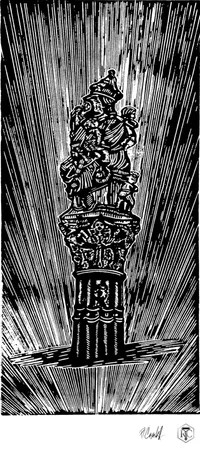
On paper, a background of parallel lines just reads as rays of light. On video, you see that every single one of those lines was cut by hand. And that a cut can’t be undone. One slip and the line stays.
My favourite moment is the lift. I print without a press, just a bamboo baren and my hand. Until I peel the sheet off, I don’t know exactly how it came out. Those few seconds are the most exciting part of the whole print, and you can only really show them on video. A photo of it is just a sheet of paper.
How the design gets onto the plate in the first place is a story of its own: how I turn photos into linocuts.
Am I any good at editing?
No. Not really.
I love making videos, and I love editing them even more. But I’m not great at it. Sometimes I watch one back and think, that could have been better. Then I post it anyway.
Maybe that’s fine. In a linocut, the small differences between two sheets prove that no machine was involved. My videos are a bit like that: you can tell there’s no agency behind them. Just me and a lot of enthusiasm.
Linocut is calming for me, close to meditation. The videos are my way of letting other people share a bit of that calm.
How can you ask me about linocut?
The easiest way is a DM on Instagram. If you want to know which knife I use for a certain line, why a print comes out patchy, or how to transfer a design in mirror image: just message me.
It took me a long time to stick with lino myself. I found it years ago, made one or two small motifs, put it away, and came back roughly every two years. Only in winter 2025/26 did I fully commit. So I know what it’s like to have questions and nobody to ask.
If you’re curious about the knives and paper I use, they’re all here: my tools.
If you’d like to watch a plate turn into a print, follow me on Instagram @rc_prints_ and send me a message with your question.