Fight Club Art Print: The Ending as a Linocut
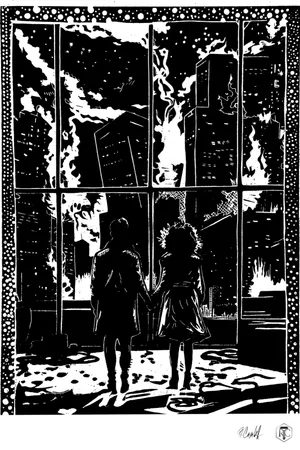
The Window is my linocut of the Fight Club ending. Why that final scene stays with me, and how city lights and falling towers become lines cut by hand.
Spoiler warning: this piece gives away the ending of Fight Club. If you haven’t seen the film yet, watch it first and come back.
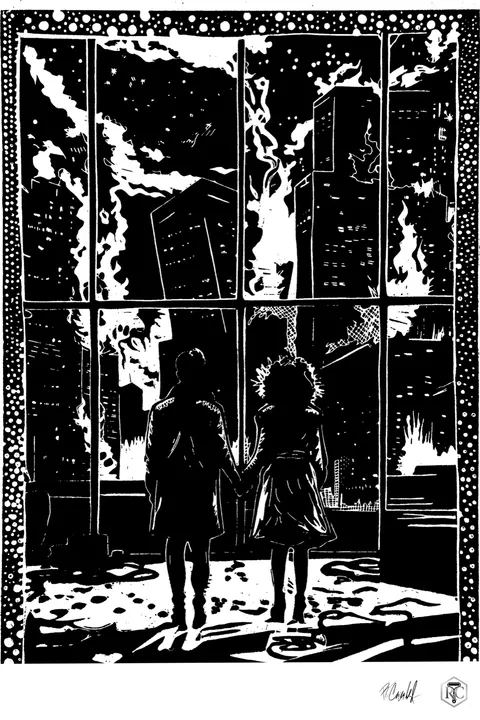
Two people stand hand in hand at a huge window. Outside, the skyscrapers come down one after another. That’s the final scene of Fight Club, and it’s the scene I cut into lino as “The Window”.
Why Fight Club?
Fight Club is one of the best films I’ve ever seen. David Fincher made it in 1999, based on Chuck Palahniuk’s novel. Edward Norton plays the unnamed narrator, Brad Pitt plays Tyler Durden and Helena Bonham Carter plays Marla Singer.
The idea behind it is incredibly catchy, and the cast is spot on. Sadly, films like this hardly get made anymore. It’s not nostalgia talking. I just miss films that stay in your head for that long.
What happens at the end of Fight Club?
The narrator realises that Tyler never existed. His best friend, the man who taught him everything, was part of him all along. Everything that happened, he was the one behind it.
To get rid of Tyler, he has to shoot himself. The bullet goes through his cheek, he survives, and Tyler is gone. Then Marla is brought in. The two of them stand at the window, he takes her hand, and the towers outside sink to the ground while “Where Is My Mind?” by the Pixies plays.
For me, that’s an amazing ending. Everything falls apart, and in the middle of it two people stand completely still. Nothing more needs saying.
Watch it a second time and it becomes a different film. You start spotting the small hints that were there all along. That’s why I wanted to hold on to this last look out of the window, the moment when everything finally makes sense.
How do city lights and falling towers become lines?
The scene happens at night, and on screen it’s full of light: lit offices, explosions, fire. In a linocut, though, there is no grey, only ink or paper. So every light has to be cut out. Whatever the knife removes stays white. Whatever’s left prints black.
This is how I built the scene:
- The towers stay as black blocks. The lit offices inside are tiny, short cuts, row after row.
- Fire and smoke are big white shapes with soft, curling edges. That’s where the knife gets to run free.
- The window splits the picture into panels with its frame. It turns the chaos outside into something you look at like a painting.
- The two figures are pure silhouettes, black against a pale floor. No faces, just posture and two hands holding on.
- The border of white dots all around was dug out with a round gouge, one dot at a time. I didn’t count them. That was probably for the best.
The towers show how well lino suits a city at night. A few hundred small cuts, and suddenly a building lights up. I go into how light turns into lines in my prints in how light becomes lines.
How is a print like this made by hand?
As with all my motifs, I first redraw everything by hand and transfer it to the plate in mirror image. Then it’s cutting, with Pfeil knives from Langenthal. A cut can’t be undone, and the rows of office windows need a steady hand.
There’s no press. I roll on the ink, lay the paper down and rub it with a bamboo baren. Every sheet is pulled on its own, so no two prints look exactly alike. Sometimes the towers come out a deeper black, sometimes the flames glow a little brighter.
The paper is Hahnemühle Sumi-E, a slightly rough, absorbent Japanese-style sheet. Each original is signed and numbered in pencil and comes with a certificate of authenticity.
How many prints are there?
There are 30 in the shop. Once they’re sold, I cut the plate into pieces, and The Window will never be printed again. For a motif about destruction, that feels oddly right.
CHF 5 from every original goes to übrig, a Bern association I co-founded.
The Window isn’t my only film linocut. You can read how I reduced Mia from Pulp Fiction to black and white in Mia as a linocut.
If that ending never quite left you either, you’ll find The Window as an original in the shop.
Prints in this article
Questions
Which scene does The Window show?
The final scene of Fight Club: the narrator and Marla stand hand in hand at the window, watching the buildings collapse.
Is The Window a film still?
No. It's my own drawing, inspired by the film, drawn by hand and cut into lino.