Bern's Fountains and the Child Eater: From Stone to Linocut
Bern has over 100 fountains, and one of them eats children. The Child Eater fountain, its contested history, and how it became my linocut The Fountain.
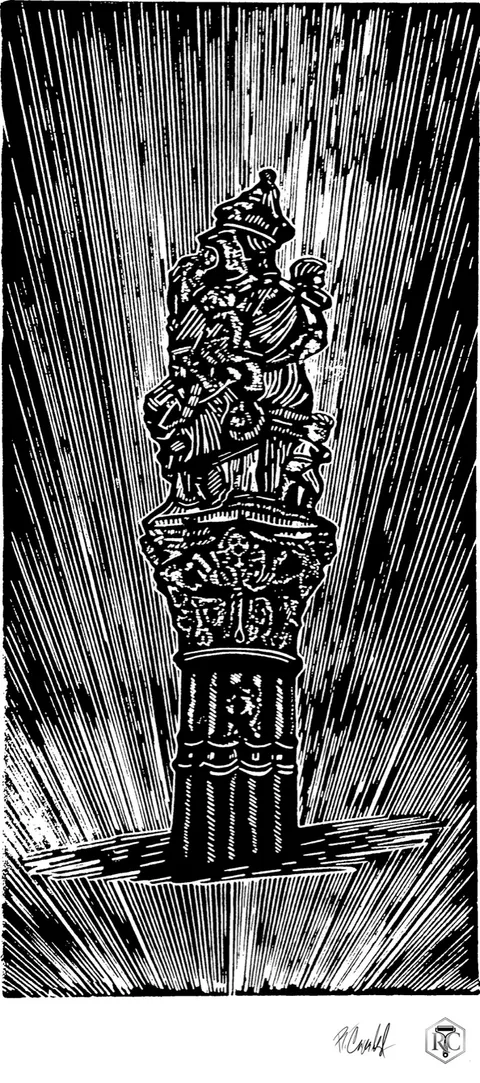
In the middle of Bern’s old town, a giant sits on a column eating a child. More children are stuffed in a sack at his side. He has been doing this for almost 500 years, a few steps from the Zytglogge.
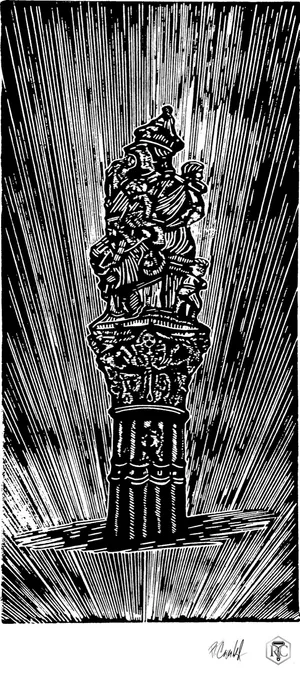
The Kindlifresserbrunnen, the Child Eater fountain, is one of the best-known fountains in Bern. For me it’s also the fountain that became my linocut “Der Brunnen, Bern”, The Fountain.
How many fountains does Bern have?
Bern has more than 100 public fountains. You can hardly walk down a lane in the old town without hearing water somewhere.
Eleven of them are special: the Renaissance figure fountains from the 16th century. Each has a painted figure standing on a column, and most are attributed to the sculptor Hans Gieng. Three I keep stopping at:
- Schützenbrunnen on Marktgasse: a standard-bearer in armour, with a small bear holding a gun between his legs.
- Läuferbrunnen on Läuferplatz, by the Untertor bridge: a city messenger walking with a young bear.
- Ryfflibrunnen on Aarbergergasse: a marksman in a feathered hat, again with an armed bear beside him.
Bears with guns, messengers, standard-bearers. And then, on Kornhausplatz, a man eating children.
What is the history of the Child Eater fountain?
The fountain dates from around 1545/46. The figure is attributed to Hans Gieng, a sculptor from Fribourg who worked in Bern in the 1540s. It replaced an older wooden fountain.
At first it was simply called the Platzbrunnen, the square fountain. The name Kindlifresserbrunnen only appears in 1666. “Kindli” is Swiss German for a little child.
The ogre sits with a naked child halfway into his mouth. Around the base, armed bears march off to war with a piper and a drummer. There is no inscription telling you what any of it means, and that is exactly why it’s still such a puzzle.
What does the Child Eater mean?
Honestly, nobody knows for sure. The most common reading is a bogeyman meant to scare children into behaving or to keep them away from the water. Others see the Greek god Cronus, who ate his children, or a carnival figure.
There is also a darker reading. Since at least the 19th century, the figure has been interpreted as an antisemitic image, a reference to the old blood libel against Jews. Whether that was the intention from the start is disputed among historians.
In 2024 the City of Bern added a new information text that names this reading too. I think that’s right. Anyone standing in front of the fountain should know both things: that it’s a piece of the city’s history, and that it can hurt people. Swissinfo has a good piece on it, and the basics are on Wikipedia.
Why this fountain?
Because it fascinates me. It has a gripping history, and the simple fact that someone, a monster, is eating children is creepy enough on its own. I can’t let go of it.
Then there’s the shape. A figure on a tall column is made for a narrow portrait format. In the print the Child Eater stands on his column, and all around him parallel cuts run outwards like rays of carved light. The background is almost nothing but lines.
There’s no grey in a linocut, only ink or paper. So every detail of the figure, the folds, the sack, the children’s heads, has to work as either a solid shape or a line. And every cut is final.
These days I prefer to transfer my drawings by redrawing the whole thing by hand, mirrored of course. And yes, more than once I’ve had a motif half cut before realising I’d forgotten to mirror it. With a fountain half of Bern knows by heart, a back-to-front Child Eater would not have gone unnoticed.
The street is our gallery
The fountains are only the start. Bern is full of art that costs nothing and never closes: sculptures, reliefs, murals.
The map Kunst in Bern by the association übrig shows 493 public artworks. Every work has its own page, including the Child Eater fountain, and one button shows you the nearest work and the walking route there. Why CHF 5 from every original I sell goes to übrig is in the piece on buying art in Bern that gives back.
If you’d like the Child Eater on your own wall, The Fountain, Bern is in the shop as a hand-pulled original. And how a drawing turns into all those rays is in my article about the lines.
Prints in this article
Questions
Where is the Child Eater fountain in Bern?
On Kornhausplatz in Bern's old town, a short walk from the Zytglogge clock tower. It's on the street, open to everyone, day and night.
What does the Child Eater fountain mean?
Nobody knows for certain; there is no inscription or document explaining it. The most common reading is a bogeyman meant to scare children into behaving. The figure is also read as antisemitic, which is why the City of Bern added an information text in 2024.
How many figure fountains does Bern have?
Bern has over 100 public fountains. Eleven of them are 16th-century Renaissance figure fountains in the old town, most attributed to the sculptor Hans Gieng.