Line Art Linocut: How Lines Became Rays of Light
How a love of technical drawing shaped my linocut style: backgrounds of parallel carved lines that read as rays of light. Plus linocut ideas to find yours.
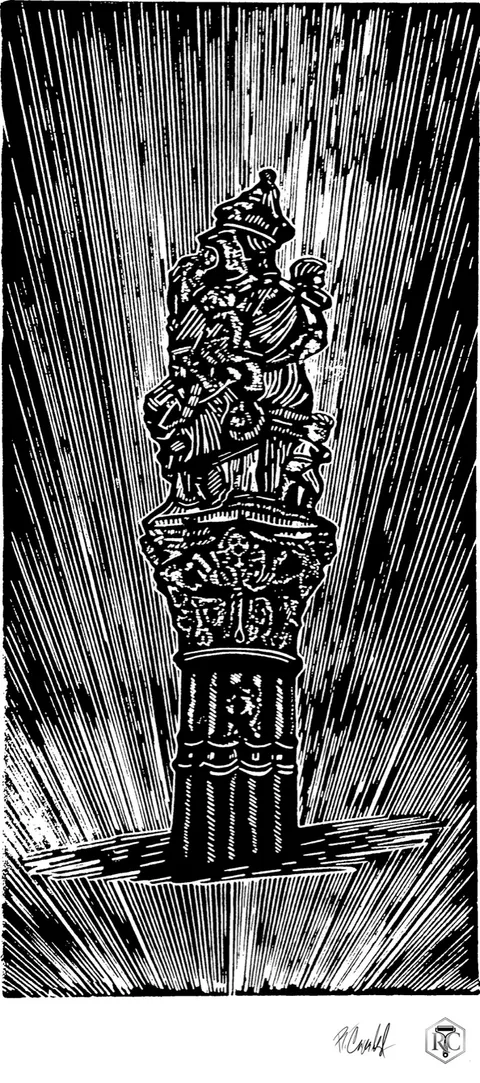
Even at school I loved technical drawing. Ruler, compass, clean lines. I had no idea that years later it would turn into a line art linocut style where light is made of straight lines.
These days I carve backgrounds of parallel lines that look like rays of light. This is how that happened.
Where does my linocut style come from?
I’ve always loved drawing. Not in an academic way, more intuitively, but always leaning towards the geometric: straight edges, clean spacing, areas built up out of lines.
That’s exactly what drew me to technical drawing. A line is a decision. It’s either there or it isn’t. And out of lots of those decisions you end up with an object, a room, a building.
Linocut works the same way, only stricter. Once something is cut, it stays cut.
Coming back to lino, again and again
I first came across linoleum years ago. I carved one or two small motifs and then put it away. Roughly every two years I’d get it out again, carve a bit, and stop.
To be honest, it took me a long time to understand what kept pulling me back. Only in the winter of 2025/26 did I properly commit to it. I’ve stuck with it since, and I still love it.
What keeps me there is the calm. Carving is like meditation for me. My head goes quiet, my hands work, and time runs differently. When you’re cutting one parallel line after another, you simply can’t think about anything else.
Light without grey: how line work creates tone
There is no grey in a linocut. There’s only ink or paper. That sounds like a limitation, and at first it was one for me too.
The answer is as old as engraving: hatching. Light and shadow come from the density and direction of the lines.
- Density: lines packed close together make an area read dark. Spread them out and it turns light.
- Width: when the carved grooves get wider, more paper shows through and the area brightens.
- Direction: lines that all run towards a point, or radiate away from it, pull the eye there. That’s how my rays come about.
Once the lines fan out in parallel from one corner, the eye stops reading them as lines. It reads them as light falling into the picture.
The tricky part is that a cut can’t be taken back. If a line comes out too wide, that spot has more light in it forever. So I plan the spacing on the block first and then carve calmly, one line after the next, without looking ahead to the end.
The Fountain and The Ladder: rays of carved light
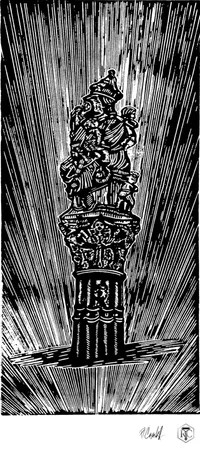
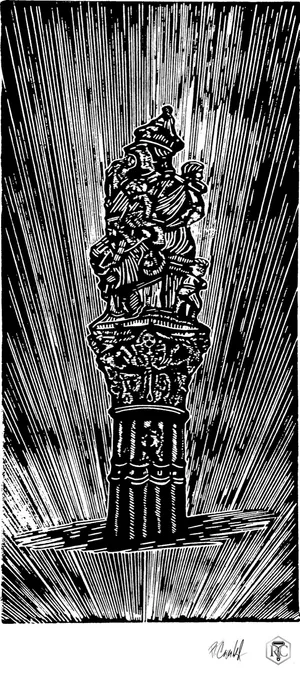
You can see it most clearly in The Fountain. A figure stands on a column, and everything around it is light made from carved lines. The figure itself is still. All the movement comes from the background.
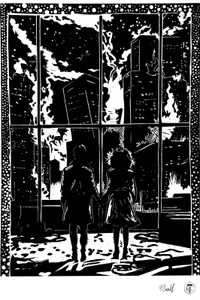
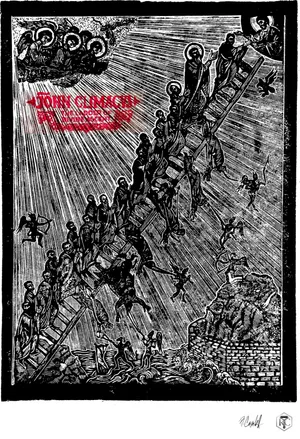
In The Ladder the rays sit behind the figures. They give the image depth and an upward pull without me having to explain anything. I’ve written more about that motif in the post on The Ladder.
A background like that takes patience. One wrong line stands out immediately because it breaks the rhythm. That’s where technical drawing still helps me: even spacing, steady direction, no rushing.
Linocut ideas: finding a style of your own
I don’t think you plan a style. Mine grew out of what I already liked doing most. A few ideas if you’re just starting:
- Look at what you already enjoy drawing. For me it was lines and geometry. For you it might be plants, faces or patterns.
- Make one area out of lines only. Take a small offcut of lino and try carving a gradient from dark to light using nothing but spacing.
- Play with direction. The same area feels calm with horizontal lines and full of energy with radiating ones.
- Start from a photo. A photo forces you to translate light into black and white. I explain how I do it in linocut from a photo.
And if you carve a couple of motifs and then put the lino away for a while, that isn’t failure. It took me a few attempts too.
If you’d like to see the rays of light for real, have a look at The Fountain in the shop, every sheet printed by hand with a baren.
Prints in this article
Questions
How do you show light in a linocut if there is no grey?
Through the density and direction of the lines. Lines set close together read as dark, lines set far apart read as light. That gives you light and shadow with only two tones.
What is a line art linocut?
A linocut that builds up shapes and tones mainly with lines, much like the hatching in an engraving. In my prints it's mostly parallel lines in the background.