Ladder of Divine Ascent Icon as a Linocut: My Biggest Print
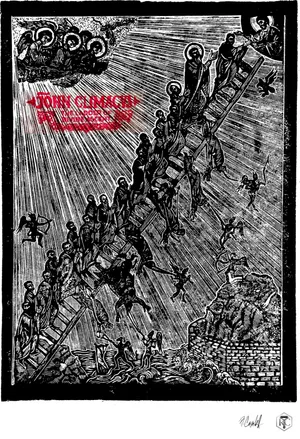
The Ladder of Divine Ascent icon, hand-cut as an A3 linocut: around 50 hours, 30 rungs, monks and demons. The story behind John Climacus' ladder.
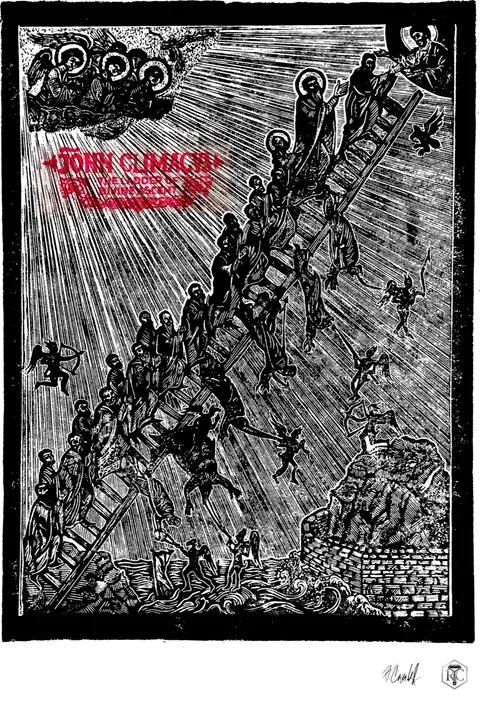
Around 50 hours. Maybe more, because at some point I stopped counting. That is how long The Ladder took me, my largest linocut so far and my version of an icon that has been making people think for more than 800 years.
Monks climb a steep, diagonal ladder towards Christ. Demons tug at them on the way up. Not everyone reaches the top.
What is the Ladder of Divine Ascent icon?
The image comes from a book. Around AD 600, John Climacus, a monk at St Catherine’s Monastery at the foot of Mount Sinai, wrote a guide to the spiritual life and called it Klimax, Greek for “ladder”. In English it is usually known as The Ladder of Divine Ascent, and he himself became known as John of the Ladder.
He described that life as 30 rungs, one for each year of Christ’s life before his ministry. The lower rungs are about letting go and obedience. The middle ones are a long fight with your own weaknesses. Near the top come stillness and prayer, and finally faith, hope and love.
The best-known painting of it is still at St Catherine’s today, a panel from the late 12th century. If you look closely you’ll find:
- a ladder cutting the picture diagonally into heaven and earth
- monks climbing rung by rung, John Climacus near the top
- demons with bows, arrows, hooks and chains pulling some of them down
- Christ at the top, reaching out to those who arrive
- angels watching on one side, monks praying on the other
Wikipedia has a solid overview if you want to read more about the text itself.
Why did I turn this icon into a linocut?
Because it tells a really interesting story. It’s about overcoming yourself, and about looking at things from a different perspective.
You don’t need to be religious to recognise something in it. Everyone has a ladder of their own. Everyone knows the small demons that grab your sleeve right when you’re almost there.
I don’t want to tell you what it means, though. I think everyone should see something of their own in it. So instead of an interpretation, here is how it was made.
How do you cut an icon this detailed in lino?
First I redrew the whole composition by hand. I’ve tried carbon paper, and I transfer some drawings with a tattoo stencil printer, but redrawing everything myself still works best. By the time I pick up a knife I know every figure.
Then there’s mirroring. A linocut plate is cut in reverse so the print comes out the right way round. Lettering is where this bites hardest, and on other motifs I’ve more than once been halfway through cutting before realising I’d forgotten to flip the drawing. With “John Climacus” on this plate, I checked very carefully.
After that it’s cutting, hour after hour, with Pfeil knives from Langenthal. A cut can’t be undone. With that many tiny faces, hands and wings, it’s a long lesson in patience. For me, though, cutting is close to meditation, which feels fitting for a motif that comes from a monastery.
What makes my version of the ladder different?
Two things stand out.
The first is the name “John Climacus” in red. There is no grey in a linocut, only ink or paper, so one red element is enough to show the eye where the story begins.
The second is the rays behind the figures. The original icon has a gold background, and gold isn’t something I can roll on with black ink. So I cut parallel lines that read as light behind the scene. Those rays turn up in a lot of my prints, and I wrote about where they come from in how light becomes lines.
There’s no press involved. I lay the paper on the inked plate and rub it by hand with a bamboo baren. On an A3 plate that takes a while, and every sheet comes out slightly different. Those small differences are the proof that no machine touched it.
What do you get with the original?
The image measures 29.7 × 42 cm on a 32.5 × 50 cm sheet of Hahnemühle Sumi-E, a soft, absorbent Japanese-style paper. The Ladder comes framed, signed and numbered in pencil, with a certificate of authenticity, and ships from Bern.
The edition is limited to 30. Once all 30 are sold, I cut the plate into pieces so it can never be printed again. After 50-odd hours that’s a strange thought, but it’s also what makes each sheet count. CHF 5 from every original goes to übrig, a Bern association I co-founded.
So I’m curious: where are you on your own ladder right now, and what tends to pull you back down a rung?
If the image has stayed with you, The Ladder is available as a framed original in the shop.
Prints in this article
Questions
What is the Ladder of Divine Ascent?
A book written around AD 600 by John Climacus, a monk at St Catherine's Monastery on Mount Sinai. It describes spiritual life as a ladder of 30 rungs, from renouncing the world up to faith, hope and love.
How big is The Ladder linocut?
The image is A3 (29.7 × 42 cm), printed on a 32.5 × 50 cm sheet. The original comes framed.
How long did it take to make?
Around 50 hours, probably more, counting the redrawing and cutting of the whole plate.