Limited Edition Print Meaning: Why I Destroy the Plate
Buying an original linocut? What signed and numbered really means, what an edition of 30 is, and why I cut the plate to pieces once it sells out.
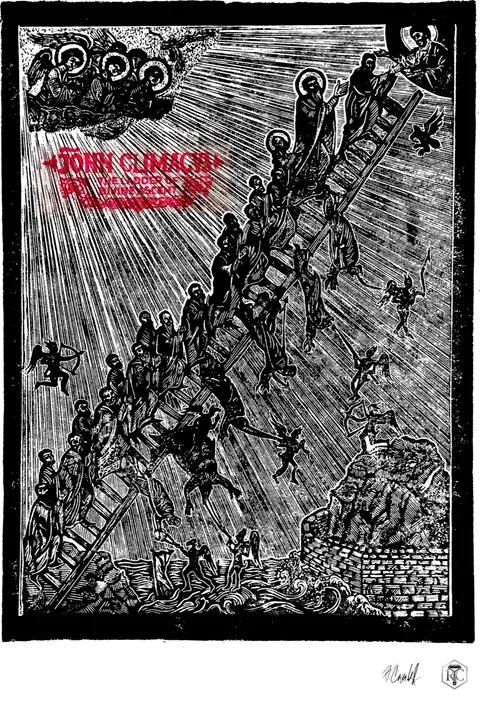
When the thirtieth sheet of a motif sells, I take a knife and cut the lino plate into pieces. The same plate I spent hours carving.
It sounds harsh, I know. But that’s exactly what you’re paying for when you buy an original linocut with “7/30” pencilled on it. Here’s what original, edition and signature actually mean, in plain terms.
What counts as an original linocut?
An original is a sheet printed directly from the lino plate. In my studio that means:
- I carve the design into the plate in mirror image, with knives.
- I roll ink onto it.
- I lay the paper on top and rub it by hand with a bamboo baren.
- I pull the sheet off, one at a time.
There’s no press involved. None. The paper is Hahnemühle Sumi-E, a Japanese-style paper at 80 g/m², natural white, slightly rough and very absorbent. An A3 motif measures 29.7×42 cm on a 32.5×50 cm sheet.
So when you buy original art like this, you’re not buying a picture of a picture. You’re buying the sheet that lay on the plate.
Why is no sheet identical to the next?
Because my hand isn’t a machine. When I rub with the baren, I never press exactly the same way twice. In one spot the paper takes a little more ink, in another a little less.
There’s no grey in a linocut, only ink or paper. Even so, a black area on sheet 3 never looks quite the same as on sheet 12. Those small differences are proof that no machine was involved. Put two sheets side by side and you can see the hand.
And the hand makes mistakes too. More than once I’ve had a motif half carved before realising I’d forgotten to mirror it, so the print would have come out back to front. And you can’t undo a cut.
What does limited edition actually mean?
The edition is the total number of sheets that will ever exist of one motif. In my shop, that’s 30 per motif.
The numbering is written in pencil at the bottom of the sheet, for example 7/30. The first number is your sheet, the second is the size of the edition. Next to it is my signature, also in pencil. That’s what a signed and numbered print is.
Why it matters:
- The number is a promise. 30 means 30, not “30 and then a few more”.
- The scarcity is real. Your motif exists exactly 30 times.
- Pencil can’t be copied. Any printer can reproduce a printed signature; nobody can reproduce a pencil line drawn on the paper itself.
Every original comes with a certificate of authenticity. And to keep the promise, there’s the knife: once the 30 are sold, I cut up the plate. No reprint, no “second edition”, not even if someone asks nicely.
What is an open edition?
An open edition has no fixed limit. I print as many as are needed.
In my case, those are the small prints at 11.5×16 cm. They’re signed and dated, but not numbered. A number like “7/30” wouldn’t make sense there, because there’s no 30 that will ever fill up.
Open edition doesn’t mean worse. It means smaller, more affordable, and without the promise of scarcity.
Original or reproduction: what’s the difference?
Alongside the originals, there are reproductions. They’re a completely different thing, and I want that to be clear.
| Original | Reproduction | |
|---|---|---|
| How it’s printed | from the lino plate, by hand, with a baren | giclée, 12-colour pigment |
| Who prints it | me | a print partner |
| Paper | Hahnemühle Sumi-E, 80 g/m² | 200 g/m², matte |
| Signed | yes, signed and numbered | no |
| Edition | 30, then the plate is destroyed | not part of the edition of 30 |
A reproduction is a clean, faithful copy of the image. But it never touched the plate. If you love the motif and the budget is tight, it’s perfectly fine. If you want the sheet that actually came out of my hands, that’s the original.
One more detail: originals ship from Bern within 14 days, with the certificate and a postcard. And CHF 5 from every original goes to the Bern association übrig.
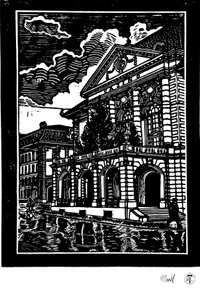
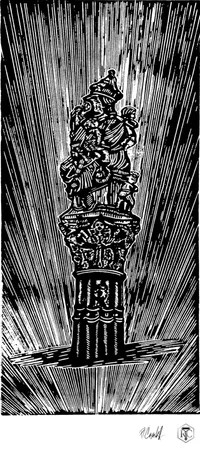
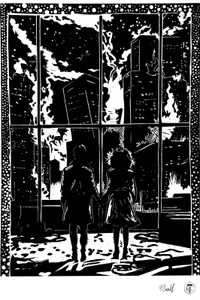
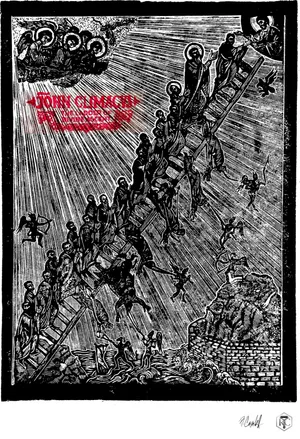
If you want to see what that looks like, have a look at The Ladder or browse all originals. To see how a motif comes to life in the first place, read how I turn photos into linocuts, or meet the knives in my tools.
Prints in this article
Questions
What does 7/30 mean on a print?
It's the seventh sheet of an edition of 30. The number after the slash tells you how many originals of that motif will ever exist.
What's the difference between an original linocut and a reproduction?
An original is hand-printed from the lino plate, signed and numbered in pencil. A reproduction is a giclée made by a print partner on 200 g/m² matte paper, and it is unsigned.
What happens when all 30 are sold?
I cut the plate into pieces, so the motif can never be printed again.