Pulp Fiction Art Print: Mia Wallace as a Linocut
Mia, a Pulp Fiction art print cut in lino: why the moment between collapse and rescue drew me in, and how a face becomes pure black and white by hand.
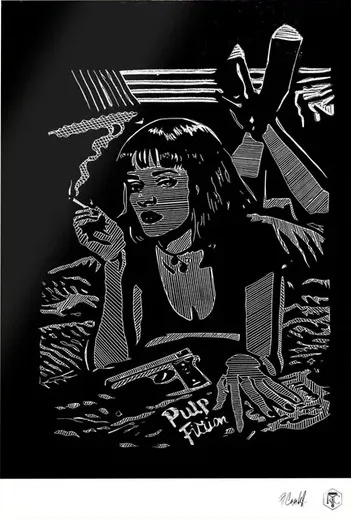
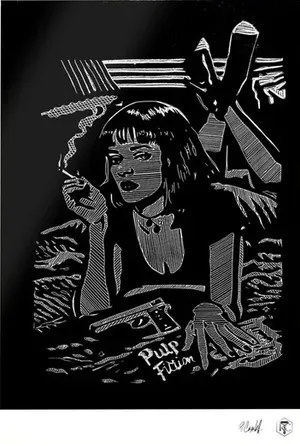
In my print she lies on her stomach, cigarette in hand, looking straight at you, completely in control. Anyone who has seen Pulp Fiction knows how far this character falls not long after. That contrast is what led me to my linocut “Mia”.
To be clear from the start: this isn’t a film still. Mia is my own drawing, inspired by the film. I drew it by hand, mirrored it and cut it line by line.
Who is Mia Wallace in Pulp Fiction?
Pulp Fiction is Quentin Tarantino’s 1994 film. Uma Thurman plays Mia Wallace, the wife of a crime boss. Taking her out for the evening is supposed to be an easy job: dinner, a twist contest, home again.
Then it all tips over. Mia overdoses and collapses. What follows is one of the most famous scenes in cinema: a frantic rescue that ends with an adrenaline shot straight to the heart.
I don’t see it as a party moment. It’s a moment between two states. She’s almost gone, and then in one jolt she’s back.
Why does Mia work as a linocut?
That’s exactly why I chose her. She completely overdoses, collapses and has to be saved. That swing between falling and coming back made it feel fitting to show her in my style.
Linocut is a blunt medium. There is no grey in a linocut, only ink or paper. Every area is either fully there or not at all. To me that echoes a scene with only two possible outcomes.
The film itself runs on contrast. Violence sits right next to jokes, and long chats about nothing turn deadly serious in a second. A print that is almost all black with a scatter of white lines feels right for that.
That’s also why I didn’t show the collapse itself. I show the confident Mia, and if you know the story, you fill in the rest. What I deliberately avoided was making drugs look good. The image doesn’t celebrate anything.
How do you turn a face into black and white?
A face in lino is harder than any building. On a house, a slightly crooked line barely shows. On a mouth or an eye, one slip turns a person into someone else. And a cut can’t be undone.
Here’s how I approached it:
- Draw, don’t trace. I redraw the whole image by hand. It’s slower, but it means I decide about every single line.
- Black as the base. Almost the entire plate stays uncut and prints black. What you read as the picture is everything I carved away.
- Hair as a dark shape. The bob with its blunt fringe stays a black mass, with only the outline and a few strands cut.
- The face in fine lines. Instead of shading there is parallel hatching. Eyes, brows and lips stay black, and the white of the paper builds the rest.
- Remember to mirror. The plate is cut in reverse, lettering included, so “Pulp Fiction” was carved back to front. I’ve forgotten to mirror on other motifs more than once.
If you want the full process of turning a reference into a linocut, I wrote it up in how I turn photos into linocuts.
How is Mia printed?
No press. I roll ink onto the plate, lay the paper on top and rub it by hand with a bamboo baren. Each sheet is pulled on its own.
With this much black you see it clearly: sometimes the ink is deep and solid, sometimes a hint of paper texture shows through. Those small differences aren’t flaws. They show every sheet was made by hand.
I print on Hahnemühle Sumi-E, a slightly rough Japanese-style paper that soaks up the ink well. Each original is signed and numbered in pencil and comes with a certificate of authenticity.
What happens after 30 prints?
The edition in the shop is limited to 30. Once they’re sold, I cut the plate into pieces, and Mia will never be printed again.
In a way that suits the scene: there’s this one moment, and then it’s over. CHF 5 from every original also goes to übrig, a Bern association I co-founded.
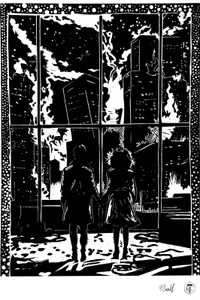
Mia isn’t my only film print. I also cut the ending of Fight Club, which I write about in The Window.
If you’d like Mia on your wall, you’ll find the Mia original in the shop.
Prints in this article
Questions
Is the Mia linocut a film still?
No. Mia is my own drawing, inspired by Pulp Fiction. I redrew it by hand and cut it into lino myself.
Why is Mia only black and white?
A linocut has no grey, only ink or paper. The face and hair have to be reduced to black shapes and white lines.